Tuesday, December 1, 2020


Friday, October 16, 2020
Brain–Machine Interfaces: Closed-Loop Control in an Adaptive System


Tuesday, May 12, 2020
Stable task information from an unstable neural population
In this paper, we test one of the hypothesis from the "Causes and consequences of representational drift" review: that neural population codes might support a stable readout, even as single neural tunings reconfigure.
We examined long-term neuroimaging recordings form Driscoll et al. (2017). We found that the population code does, indeed, preserve a stable readout over time. This is because much of the reconfiguration in the neural code is orthogonal to the directions that encode behavior.
Even this readout isn't perfectly stable, however, so some amount of ongoing compensation must occur to allow readouts to adjust to the shifting neural code. This residual reconfiguration is much slower than the apparent day-to-day variability in single neurons, so it could be easily tracked with synaptic plasticity.
Many thanks to all! This really was a team effort: data were collected by Laura Driscoll and colleagues in the Harvey lab, and most of the analysis was started by Adriana Loback. Dhruva Raman was instrumental in sorting out the null model simulations. The paper can be cited as
Rule, M.E., Loback, A.R., Raman, D.V., Driscoll, L.N., Harvey, C.D. and O'Leary, T., 2020. Stable task information from an unstable neural population. Elife, 9, p.e51121.
Excerpt: Figure 4
 |
| A slowly-varying component of drift disrupts the behavior-coding subspace. (a) The small error increase when training concatenated decoders (Figure 3) suggests that plasticity is needed to maintain good decoding in the long term. We assess the minimum rate for this plasticity by training a separate decoder Md for each day, while minimizing the change in weights across days. The parameter λ controls how strongly we constrain weight changes across days (the inset equation reflects the objective function to be minimized; Methods). (b) Decoders trained on all days (cyan) perform better than chance (red), but worse than single-day decoders (ochre). Black traces illustrate the plasticity-accuracy trade-off for adaptive decoding. Modest weight changes per day are sufficient to match the performance of single-day decoders (Boxes: inner 50% of data, horizontal lines: median, whiskers: 5–95th%). (c) Across days, the mean neural activity associated with a particular phase of the task changes (Δμ). We define an alignment measure ρ (Materials and methods) to assess the extent to which these changes align with behavior-coding directions in the population code (blue) verses directions of noise correlations (ochre). (d) Drift is more aligned with noise (ochre) than it is with behavior-coding directions (blue). Nevertheless, drift overlaps this behavior-coding subspace much more than chance (grey; dashed line: 95% Monte-Carlo sample). Each box reflects the distribution over all maze locations, with all consecutive pairs of sessions combined. |
Friday, November 1, 2019
Causes and consequences of representational drift
Drs. Harvey, O'Leary, and myself, have just published a review in Current Opinion in Neurobiology titled the "Causes and consequences of representational drift" [PDF].
We explore recent results from the work of Alon Rubin and Liron Sheintuch in the Ziv lab and Laura Driscoll in the Harvey lab. Their work has shown that neural representations reconfigure even for fixed, learned tasks.
We discuss ways that the brain might support this reconfiguration without forgetting what it has already learned. There might be a subset of stable neurons that maintain memories. Alternatively, neural representations can be highly redundant, and support a stable readout even as single cells seem to change.
Finally, we conjecture that redundancy allows different brain areas to "error-correct" each other, allowing the brain to keep track of the shifting meaning of single neurons in plastic representations.
For a brief preview, here are the pre-publication versions of figures 2 and 3:
Figure 2:
 | |
| Figure 2: Internal representations have unconstrained degrees of freedom that allow drift. (a) Nonlinear dimensionality reduction of population activity recovers the low-dimensional structure of the T-maze in Driscoll et al. (2017). Each point represents a single time-point of population activity, and is colored according to location in the maze. (b) Point clouds illustrate low-dimensional projections of neural activity as in (a). Although unsupervised dimensionality-reduction methods can recover the task structure on each day, the way in which this structure is encoded in the population can change over days to weeks. (c) Left: Neural populations can encode information in relative firing rates and correlations, illustrated here as a sensory variable encoded in the sum of two neural signals ($y_1 + y_2$). Points represent neural activity during a repeated presentation of the same stimulus. Variability orthogonal to this coding axis does not disrupt coding, but could appear as drift in experiments if it occurred on slow timescales. Right: Such distributed codes may be hard to read-out from recorded subpopulations (e.g. $y_1$ or $y_2$ alone; black), especially if they entail correlations between brain areas. (d) Left: External covariates may exhibit context-dependent relationships. Each point here reflects a neural population state at a given time-point. The relationship between directions $x_1$ and $x_2$ changes depending on context (cyan versus red). Middle: Internally, this can be represented a mixture model, in which different subspaces are allocated to encode each context, and the representations are linearly-separable (gray plane). Right: The expanded representation contains two orthogonal subspaces that each encode a separate, context- dependent relationship. This dimensionality expansions increases the degrees of freedom in internal representations, thereby increasing opportunities for drift. |
Friday, July 13, 2018
Local learning rules to attenuate forgetting in neural networks
- We noticed that measures of synaptic importance were available from local firing statistics (at least in Boltzmann machines)
- We look at an artificial neural network that stores memories and is easy to analyze. (Hopfield nets are the zero temperature limit of a Boltzmann machine).
- We evaluated whether this local measure of synaptic importance could help stabilize important weights when networks learn multiple things that interfere with each-other
- Intuition: biological variables, like synapse size, can correlate with useful statistical quantities. This provides tricks for biologically-plausible approximations of algorithms.
- Intuition: in systems that learn, if a parameter takes on an unusual or surprising value, it is likely that this value was set through learning—and you might want to leave it fixed.
Wednesday, February 28, 2018
Optimal encoding in stochastic latent-variable models
Update: the review process for this was a long one, But! It is published now, in Entropy [PDF].
The sensory system encodes the external world using spiking population codes, and must contend with the fixed bandwidth and noise inherent to neural communication. In this work, we explored a machine-learning model that shares similar constraints, and examined the coding strategies it learned when trained to encode visual input.
We used Restricted Boltzmann Machines (RBMs), which are a two-layer stochastic binary neural network that learn generative models of their inputs. We explored how optimized encoders handle limited encoding resources by varying the number of binary "neurons" available to represent visual inputs.
We found several statistical signatures that emerge around an "optimal" model size: one that is just large enough to encode its inputs. Around the optimal model model size, we saw emergence of statistical features often observed in neural population codes: sparsity, decorrelation, statistical criticality, and variability suppression.
We interpret the learned encoding strategies as a way to encode stimuli with variable bit-rates over a noisy channel of fixed bandwidth. Low-noise regions of coding space are reserved for stimuli that take the most bits to describe. In our simulations, the networks learned to suppress noise by strongly silencing some neurons.
Common stimuli don't require very many bits to transmit (from a Shannon coding perspective). Such stimuli are encoded in the noisier regions of the neural code, and exhibit increased variability. Increase neural variability in the presence of limited information is another feature observed in neural population codes.
Preview: Figure 5
 |
Analyses of parameter sensitivity suggests an optimal model size for encoding sensory statistics: (a) Analysis of the Fisher Information Matrix (FIM) over a range of hidden-layer sizes (top to bottom; 13 visible units). From left to right, (1) FIM eigenvalue spectra $\lambda_i$ (y-axis) over a range of inverse temperatures β indicate that model fits (β=1) past a certain size lie at a peak in their generalized susceptibility. This is a correlate of criticality in Ising spin models. Eigenvalues below $10^{−5}$ are truncated, and the largest and smallest eigenvalues are in red; (2) Important parameters in the leading FIM eigenvector align with individual hidden units, and become sparse for larger hidden layers. The eigenvector is displayed separately for the weights (matrix), and the visible (vertical) and hidden (horizontal) biases; (3) The average sensitivity of each parameter over all FIM eigenvectors, shown here as the square root of the FIM diagonal, also shows sparsity, indicating that beyond a certain size additional hidden units contribute little to model accuracy. Data is shown as in column 2; (4) Variance of the hidden unit activation as a function of stimulus energy. In larger models, units with sensitive parameters contribute to encoding low energy, less informative patterns. (b) The average sensitivity of each parameter, measured by the trace of the FIM, normalized by hidden-layer size, decreases as hidden-layer size grows. (c) Hidden unit projective fields from a model with 37 visible and 60 hidden units, ordered by relative sensitivity (rank indicated above each image). More important units (ranks 1–8) encode spatially simple features such as localized patches, while the least important ones (ranks 53–60) have complex features. |
Overall,
Rule, M.E., Sorbaro, M. and Hennig, M.H., 2020. Optimal encoding in stochastic latent-variable Models. Entropy, 22(7), p.714.
Monday, January 1, 2018
Autoregressive point-processes as latent state-space models
In 2016 I started a postdoc with the labs of Guido Sanguinetti and Matthias H. Hennig—and this is the first paper to result!
A central challenge in neuroscience is understanding how the activity of single cells combines to create the collective dynamics that underlie perception, cognition, and behavior. One way to study this is to build detailed models, and "coarse grain" them to see which details are important.
Our paper develops ways to relate detailed point-process models to coarse-grained quantities, like average neuronal firing rates and correlations. Point-process models are used for statistical modelling of spike train data. They can reveal effective neural dynamics by capturing how neurons in a population inhibit or excite each-other and themselves.
Preview of figures:
 |
| (A) Log-linear autoregressive PPGLM framework (e.g., Weber & Pillow, 2017). Dependence on the history of both extrinsic covariates x(t) and the process itself y(t) are mediated by linear filters, which are combined to predict the instantaneous log intensity of the process. (B) Latent state-space models learn a hidden dynamical system, which can be driven by both extrinsic covariates and spiking outputs. Such models are often fit using expectation- maximization, and the learned dynamics are descriptive. (C) Moment closure recasts autoregressive PPGLMs as state-space models. History dependence of the process is subsumed into the state-space dynamics, but the latent states retain a physical interpretation as moments of the process history (dashed arrow). (D) Compare to neural mass and neural field models, which define dynamics on a state space with a physical interpretation as moments of neural population activity |
Thursday, January 26, 2017
Optogenetic stimulation shifts the excitability of cerebral cortex from type I to type II
Our new paper, Heitmann et al. [get PDF], is finally out! It's a collaboration between the theoretical neuroscientists Stewart Heitmann and Bard Ermentrout at the University of Pittsburgh, and the Truccolo lab at Brown University.
This work could help us understand what happens when we stimulate cerebral cortex in primates using optogenetics. Modeling how the brain responds to stimulation is important for learning how to use this new technology to control neural activity.
Optogenetic stimulation elicits gamma (~50 Hz) oscillations, the amplitude of which grows with the intensity of light stimulation. However, traveling waves away from the stimulation site also emerge.
It's difficult to reconcile oscillatory and traveling-wave dynamics in neural field models, but Heitmann et al. arrive at a surprising and testable prediction:
The observed effects can be explained by paradoxical recruitment of inhibition at low levels of stimulation, which changes cortex from a wave-propagating medium to an oscillator.
At higher stimulation levels, excitation overwhelms inhibition, giving rise to the observed gamma oscillations.
Many thanks to Stewart Heitmann, Wilson Truccolo, and Bard Ermentrout. The paper can be cited as:

Dissociation between sustained single-neuron spiking and transient β-LFP oscillations in primate motor cortex
Chapter two of my thesis has just been published! Rule et al. 2017 [PDF] explores the neurophysiology of beta (β) oscillations in primates, especially how single-neuron activity relates to population activity reflected in local field potentials (a.k.a. "brain waves").
Beta (~20 Hz) oscillations occur in frontal cortex. We've known about them for about a century, but still don't understand how they work or what they do. β-wave activity is related to "holding steady", so to speak.
Beta oscillations are dysregulated in Parkinson's, in which movements are slowed or stopped. Beta oscillations are also reduced relative to slow-wave activity in ADHD, a disorder associated with motor restlessness and hyperactivity.
I looked at beta oscillations during movement preparation, where they seem to play a role in stabilizing a planned movement. I found that single neurons had very little relationship to the β-LFP brain waves. However! This appears to be for a good reason: the firing frequencies of neurons store information about the upcoming movement, and neurons firing at different frequencies cannot phase-lock together into a coherent population oscillation.
Anyone who's played in an orchestra knows that when notes are just slightly out of tune, you get interference patterns called beats. The same thing is happening in the brain, where many neurons firing at slightly different "pitches" cause β-LFP fluctuations, even though the underlying neural activity is constant.
This result provides a new explanation for how β-waves can appear as "transients" during motor steady-state: the fluctuations are cased by "beating", rather than changes in the β activity in the individual neurons. This differs from the prevailing theory for the origin of β transients in more posterior brain regions.
Many thanks to Carlos Vargas-Irwin, John Donoghue, and Wilson Truccolo. You can grab the PDF here. Please cite as
Rule, M.E., Vargas-Irwin, C.E., Donoghue, J.P. and Truccolo, W., 2017.
Dissociation between sustained single-neuron spiking and transient β-LFP oscillations in primate motor cortex. Journal of neurophysiology, 117(4), pp.1524-1543.

Monday, June 6, 2016
Collective neural dynamics in primate motor cortex
As of the 29th of May, 2016, I officially have a Ph.D. in neuroscience! The thesis, Collective Neural Dynamics in Primate Motor Cortex, is available from the Brown University library [PDF].
I studied how single-neuron activity relates to large-scale collective neural dynamics during movement planning and execution. The thesis covers three research projects, which have been (will be) published as stand-alone papers:
- Chapter 2, pp. 88-121: Contribution of LFP dynamics to spiking variability in motor cortex during movement execution. read more...
- Chapter 3, pp. 122:168: Dissociation between single-neuron spiking β-rhythmicity and transient β-LFP oscillations during movement preparation in primate motor cortex. read more…
- Chapter 4, pp. 169-213: Phase diversity and spatiotemporal wavedynamics in primate motor cortex local field potentials. read more…
The introduction contains background on primate motor cortex (Chapter 1, pp. 7-88), including its constituent areas, how they connect with the rest of the brain, and how neurons connect to each-other within each area. It surveys what is known (as of 2016) about motor cortex population dynamics, LFP oscillations, and spatiotemporal waves. The section on statistical methods (Chapter 1.5, pp. 61-87) provides background for signal processing to extract single-neuron spikes and LFPs from multi-electrode array recordings. It also covers how to apply Generalized Linear Point-Process Models (PP-GLM) to analyze spiking neural data.
I'd also like to share two new illustrations from the introduction not published elsewhere:
Figure 1.1
(high resolution PDF, SVG)
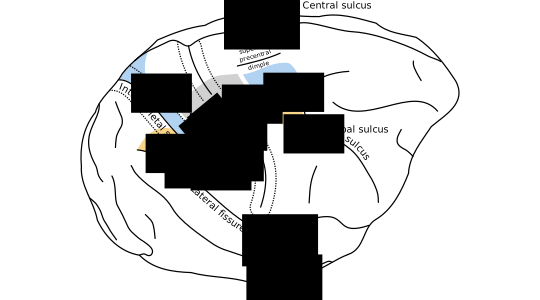
 | |
| Figure 1.1: Anatomy of visually-guided reaching and grasping. During visually guided reaching and grasping, the arm and hand area of M1 coordinates with the dorsal and ventral premotor areas PMd and PMv. In this illustration, reciprocally connected motor and parietal areas are shaded in common colors. Premotor areas receive segregated streams of visual information from parietal cortex. Area PMd receives information about spatial geometry important for reaching from dorsal parietal areas (shaded in blue). Area PMv receives information about object geometry important for grasping from the parietal areas shaded in orange. Area M1 also receives feedback from somatosensory cortex (areas 3a,1,2, shaded in grey). Connections between parietal and premotor cortex are taken from Tanné-Gariépy et al. (2002), and anatomical boundaries of premotor areas are taken from Dum and Strick (2002). |
Wednesday, July 8, 2015
Contribution of LFP dynamics to single-neuron spiking variability in motor cortex during movement execution
My first Ph.D. publication is out! Contribution of LFP dynamics to single-neuron spiking variability in motor cortex during movement execution explores how the activity of individual neurons in motor cortex is related to population activity, as measured by electrical Local Field Potentials (LFPs).
[get PDF]
How do the actions of individual cells combine to create the emergent dynamics that underlie perception, thought, and action? To answer this question, we should study populations of single neurons, and ask how their activity is related to measures of collective population dynamics.
This study was a collaboration between the Truccolo and Donoghue labs, and looked at neural population recordings from primate
motor cortex during movement.
We found that the activity of single cells was tightly coupled to population activity as measured by LFPs, and that both of these signals were closely realated to movement. This suggest that, during movement execution, collective dynamics reflected in motor cortex LFPs mostly reflect the sensorimotor processes directly controlling movement output. It also suggests that primary motor cortex isn't engaged in other activities like cognition or future planning, while executing movements.
Importantly, we considered both past and future movement in this analysis, and found that single neurons and LFPs both contain information about recent and upcoming movements. This is consistent with the view that motor cortex acts as a dynamical pattern generator.
Many thanks to Carlos Vargas-Irwin, John P. Donoghue, and Wilson Truccolo. The article is open access, and you can also grab the PDF from Github. The paper can be cited as:
Rule, M.E., Vargas-Irwin, C., Donoghue, J.P. and Truccolo, W., 2015.
Contribution of LFP dynamics to single-neuron spiking variability in
motor cortex during movement execution. Frontiers in systems
neuroscience, 9, p.89.
 |
| Figure 4. Breakdown of LFP predictive power by frequency band and LFP feature. Box-plots over the population of isolated units (all sessions combined) showing the predictive power of models based on phase, amplitude, or analytic signal features in isolation from each of eight LFP bands. To better assess the individual predictive power of each LFP feature, models were fitted for each feature separately. Certain features, such as the instantaneous phase and analytic signal for the 0.3–2 Hz band, as well as the analytic signal amplitude modulation above 100 Hz, consistently predict spiking across all animals and areas. |
Saturday, June 29, 2013
Invent-abling: enabling inventiveness through craft
This latest paper, "Invent-abling: enabling inventiveness through craft", is a departure from the usual science.
For the outreach component of the NHS Graduate Research Fellowship Program, and I've teamed up with Deren Güler to explore ways to make early STEM education more engaging and accessible for a diverse array of young people.
We've been running workshops that merge electronics educational lessons with crafting—origami, sewing, etc. The idea was that STEM education disguised as arts-and-crafts would engage children of all genders and diverse backgrounds more equally. We felt that this would be a more natural and accessible, in contrast to simply, say, making pink breadboards.
We learned a lot, especially about circumventing biases and preconceptions concerning gender identity and patterns of play. The hands-on and open-ended approach of these workshops was also inclusive of children with differing skill levels. We presented what we've learned at the 12th International Conference on Interaction Design and Children, as a conference paper [PDF]. You can cite it as:
Guler, S.D. and Rule, M.E., 2013, June. Invent-abling: enabling inventiveness through craft. In Proceedings of the 12th International Conference on Interaction Design and Children (pp. 368-371).
The plan for the future is to establish a LLC to produce the lesson materials and components, and provide these materials to educators who wish to host similar workshops.

Edit, circa 2019: Epilogue
Thanks to Deren's dedication and persistence, this outreach program has grown into a full-fledged company, Teknikio. Teknikio provides both individual kits and classroom kits for educators. In the years since the first workshops, we've developed new workshops added many more re-usable components for kids to incorporate into their inventions.
The Gordon and Betty Moore Foundation SPARK Award was instrumental in providing start-up capital. In 2018, Teknikio received an NSF Small Business Innovation Research (SBIR) phase I grant to prototype an Internet-of-Things (IoT) kit for the classroom. In 2019, this grant was extended to a phase II award to begin commercialization. Great things start small.
Tuesday, April 10, 2007
Microrobotically fabricated biological scaffolds for tissue engineering
My first paper credit! This was a bio-engineering project. We explored a new fabrication method for building submicron-scale fibrous constructs out of the biodegradable polymer polylactic acid (PLA).
Designing fibrous, biodegradable, patterned substrates is relevant for tissue engineering: they provide a mechanical
substrate to guide the structural development of the tissue. We cultured the mouse myoblast (muscle building) C2C12 cell line (which has been immortalized since 1977) on the constructs. The cells adhered to the fibers and replicated happily.
You can download the conference paper here.
We took some beautiful confocal and electron microscopy images:


Below is a false-color confocal image of the cells proliferating on the scaffold. The PLA fibers (blue) were imaged in brightfield. The α-tubulin-GFP fluorescence is in green, with fine structures highlighted in yellow.

Here are a few more fluorescence and electron microscopy images (click on thumbnail to view full size):


If you would like to reproduce or refer to these images, you can cite the paper as:
Nain, A.S., Chung, F., Rule, M., Jadlowiec, J.A., Campbell, P.G., Amon, C. and Sitti, M., 2007, April. Microrobotically fabricated biological scaffolds for tissue engineering. In Proceedings 2007 IEEE International Conference on Robotics and Automation (pp. 1918-1923). IEEE.