Friday, October 16, 2020
Brain–Machine Interfaces: Closed-Loop Control in an Adaptive System
Thursday, January 26, 2017
Dissociation between sustained single-neuron spiking and transient β-LFP oscillations in primate motor cortex
Chapter two of my thesis has just been published! Rule et al. 2017 [PDF] explores the neurophysiology of beta (β) oscillations in primates, especially how single-neuron activity relates to population activity reflected in local field potentials (a.k.a. "brain waves").
Beta (~20 Hz) oscillations occur in frontal cortex. We've known about them for about a century, but still don't understand how they work or what they do. β-wave activity is related to "holding steady", so to speak.
Beta oscillations are dysregulated in Parkinson's, in which movements are slowed or stopped. Beta oscillations are also reduced relative to slow-wave activity in ADHD, a disorder associated with motor restlessness and hyperactivity.
I looked at beta oscillations during movement preparation, where they seem to play a role in stabilizing a planned movement. I found that single neurons had very little relationship to the β-LFP brain waves. However! This appears to be for a good reason: the firing frequencies of neurons store information about the upcoming movement, and neurons firing at different frequencies cannot phase-lock together into a coherent population oscillation.
Anyone who's played in an orchestra knows that when notes are just slightly out of tune, you get interference patterns called beats. The same thing is happening in the brain, where many neurons firing at slightly different "pitches" cause β-LFP fluctuations, even though the underlying neural activity is constant.
This result provides a new explanation for how β-waves can appear as "transients" during motor steady-state: the fluctuations are cased by "beating", rather than changes in the β activity in the individual neurons. This differs from the prevailing theory for the origin of β transients in more posterior brain regions.
Many thanks to Carlos Vargas-Irwin, John Donoghue, and Wilson Truccolo. You can grab the PDF here. Please cite as
Rule, M.E., Vargas-Irwin, C.E., Donoghue, J.P. and Truccolo, W., 2017.
Dissociation between sustained single-neuron spiking and transient β-LFP oscillations in primate motor cortex. Journal of neurophysiology, 117(4), pp.1524-1543.
Monday, June 6, 2016
Collective neural dynamics in primate motor cortex
As of the 29th of May, 2016, I officially have a Ph.D. in neuroscience! The thesis, Collective Neural Dynamics in Primate Motor Cortex, is available from the Brown University library [PDF].
I studied how single-neuron activity relates to large-scale collective neural dynamics during movement planning and execution. The thesis covers three research projects, which have been (will be) published as stand-alone papers:
- Chapter 2, pp. 88-121: Contribution of LFP dynamics to spiking variability in motor cortex during movement execution. read more...
- Chapter 3, pp. 122:168: Dissociation between single-neuron spiking β-rhythmicity and transient β-LFP oscillations during movement preparation in primate motor cortex. read more…
- Chapter 4, pp. 169-213: Phase diversity and spatiotemporal wavedynamics in primate motor cortex local field potentials. read more…
The introduction contains background on primate motor cortex (Chapter 1, pp. 7-88), including its constituent areas, how they connect with the rest of the brain, and how neurons connect to each-other within each area. It surveys what is known (as of 2016) about motor cortex population dynamics, LFP oscillations, and spatiotemporal waves. The section on statistical methods (Chapter 1.5, pp. 61-87) provides background for signal processing to extract single-neuron spikes and LFPs from multi-electrode array recordings. It also covers how to apply Generalized Linear Point-Process Models (PP-GLM) to analyze spiking neural data.
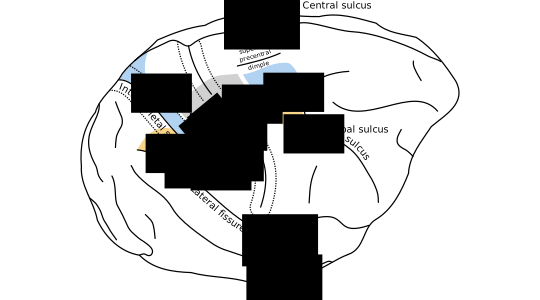
I'd also like to share two new illustrations from the introduction not published elsewhere:
Figure 1.1
(high resolution PDF, SVG)
Saturday, October 17, 2015
Diverse spatiotemporal dynamics in primate motor cortex local field potentials
Edit: this work has now been published as two papers. The first finds that mesoscopic beta-LFP oscillations may arise due to synchronization of rhythmic spiking in single neurons. The second explores how changes in synchronization relate to the diverse patterns illustrated in the poster below.
I'll present some of my ongoing thesis research at SfN as a poster this year. (This was originally titled "Identification of (~20 Hz) beta spatiotemporal dynamics in motor cortex LFPs".)
Abstract:
Modulation of beta (10-45Hz) oscillations is a prominent feature of primate motor cortex. Beta power is typically elevated during movement preparation, suppressed around movement onset, and enhanced during isometric force tasks. As shown by previous studies, beta oscillations can also appears as traveling waves in primate motor cortex. Understanding the mechanisms underlying the rapid modulation of beta LFP activity and the associated spatiotemporal patterns may shed light on the functional roles of these oscillations. It may also have important implications for movement disorders where regulation of motor cortex beta activity is abnormal (e.g. Parkinson's disease). Here, we examine motor cortex beta spatiotemporal LFP activity using multielectrode arrays (MEAs) in m. mulatta during a cued reaching and grasping task with instructed delay. Data from two monkeys are analyzed, each with a 96-MEA in ventral premotor cortex (PMv), and two 48-MEAs in the primary motor cortex (M1) and dorsal premotor cortex (PMd), respectively. Our main findings are threefold: (1) The transient nature of beta oscillation events together with variations in the beta band center frequency makes the identification of spatiotemporal structures challenging. In particular, different filtering and preprocessing steps can alter the apparent spatiotemporal dynamics. (2) Furthermore, attempts to summarize wave dynamics in terms of simple global structures, like plane waves, or rotating (radiating) waves around (from) a critical point, may fail to meaningfully describe the full range of beta spatiotemporal activity. (3) Despite these challenges, we find a variety of beta spatiotemporal patterns ranging from asynchronous states, i.e. states with no clear wave dynamics, to more locally synchronized states with complex wave dynamics, to globally coherent states. These globally coherent states may exhibit either traveling wave dynamics or homogeneous synchrony. We conjecture that the transitions among these different patterns may result from fast modulations of the effective lateral connectivity or from changes in spatiotemporal inputs to the cortical area.
This poster can be cited as
Rule, M. E., Vargas-Irwin, C., Donoghue, J., Truccolo, W. (2015) Identification of (~20 Hz) beta spatiotemporal dynamics in motor cortex LFPs. [Poster] Society for Neuroscience 2015, Oct 19th, Chicago, Il, USA.
Update: This work can now be found in the following papers
Rule, M.E., Vargas-Irwin, C.E., Donoghue, J.P. and Truccolo, W., 2017. Dissociation between sustained single-neuron spiking and transient β-LFP oscillations in primate motor cortex. Journal of neurophysiology, 117(4), pp.1524-1543.
Rule, M.E., Vargas-Irwin, C., Donoghue, J.P. and Truccolo, W., 2018. Phase reorganization leads to transient β-LFP spatial wave patterns in motor cortex during steady-state movement preparation. Journal of neurophysiology, 119(6), pp.2212-2228.
Wednesday, July 8, 2015
Contribution of LFP dynamics to single-neuron spiking variability in motor cortex during movement execution
My first Ph.D. publication is out! Contribution of LFP dynamics to single-neuron spiking variability in motor cortex during movement execution explores how the activity of individual neurons in motor cortex is related to population activity, as measured by electrical Local Field Potentials (LFPs).
[get PDF]
How do the actions of individual cells combine to create the emergent dynamics that underlie perception, thought, and action? To answer this question, we should study populations of single neurons, and ask how their activity is related to measures of collective population dynamics.
This study was a collaboration between the Truccolo and Donoghue labs, and looked at neural population recordings from primate
motor cortex during movement.
We found that the activity of single cells was tightly coupled to population activity as measured by LFPs, and that both of these signals were closely realated to movement. This suggest that, during movement execution, collective dynamics reflected in motor cortex LFPs mostly reflect the sensorimotor processes directly controlling movement output. It also suggests that primary motor cortex isn't engaged in other activities like cognition or future planning, while executing movements.
Importantly, we considered both past and future movement in this analysis, and found that single neurons and LFPs both contain information about recent and upcoming movements. This is consistent with the view that motor cortex acts as a dynamical pattern generator.
Many thanks to Carlos Vargas-Irwin, John P. Donoghue, and Wilson Truccolo. The article is open access, and you can also grab the PDF from Github. The paper can be cited as:
Rule, M.E., Vargas-Irwin, C., Donoghue, J.P. and Truccolo, W., 2015.
Contribution of LFP dynamics to single-neuron spiking variability in
motor cortex during movement execution. Frontiers in systems
neuroscience, 9, p.89.
![]() |
| Figure 4. Breakdown of LFP predictive power by frequency band and LFP feature. Box-plots over the population of isolated units (all sessions combined) showing the predictive power of models based on phase, amplitude, or analytic signal features in isolation from each of eight LFP bands. To better assess the individual predictive power of each LFP feature, models were fitted for each feature separately. Certain features, such as the instantaneous phase and analytic signal for the 0.3–2 Hz band, as well as the analytic signal amplitude modulation above 100 Hz, consistently predict spiking across all animals and areas. |
Wednesday, January 16, 2013
Impact of redundancy on stable decoding
Neural activity is redundant: many states in motor cortex can generate similar movements. When we record from motor cortex, we capture only a small fraction of the total neurons. Redundancy makes it possible to observe the overall state of motor cortex from limited observations, but might also impair the generalization performance of a linear decoder.
Consider two neurons, $A$ and $B$, that combine linearly to produce movement $C{=}\alpha_1 A{+} \alpha_2 B$. (Perhaps both neurons drive the same targets in spinal cord.) An animal could use any linear combination of activations of units $A$ and $B$ to perform behavior $C$, so long as the sum $\alpha_1{+}\alpha_2$ is constant. What if there is an unobserved variable $\gamma$ that sets whether neuron $A$ or $B$ is used more (Fig. 1)?
Wednesday, August 1, 2012
Impact of fast and slow neuronal variability in output-null dimensions on motor decoding
Output-null spaces in motor control
The idea of a null-space extends the notion of selectivity and invariance to motor cortex (Kaufman et al. 2010). Rather than asking what stimuli change the firing rate of a neuron (and what stimulus changes it is in variant to), we ask what neural activity drives movement (and what activity does not). The subspace in which neural activity in motor cortex can vary without changing behavior is called the "output-null" space.
Variables in the output-null space explains neural variability not related to an observed behavior. This residual variability may contain components related to unmeasured behavior, neural processing, and noise sources. If one has observations from behavior $X$ and output-null space $Z$, then neural covariates $Y$ are determined. Neural variability factors in to variability induced by behavior, and that induced by output-null space.